
What this guide can establish
Apollo Neuro is marketed as a consumer wearable that delivers vibration patterns through a band or clip and works with a mobile app. This guide separates maker-described features from research outcomes. The manufacturer is a primary source for its current product description, but marketing language is not independent proof that every promised benefit has been demonstrated. Published studies answer narrower questions about participants, methods, comparison groups, duration, and measured outcomes.
This is not medical advice and does not assess individual suitability. Apollo's support page says the wearable is a consumer wellness device, is not intended to treat or cure medical conditions, and is not a substitute for professional care. Regulatory status and consumer claims can change, so check the current maker statement and relevant authority when purchasing. Her Glamness has not independently tested this device; the product-testing box clarifies that distinction.
Maker-described design and use
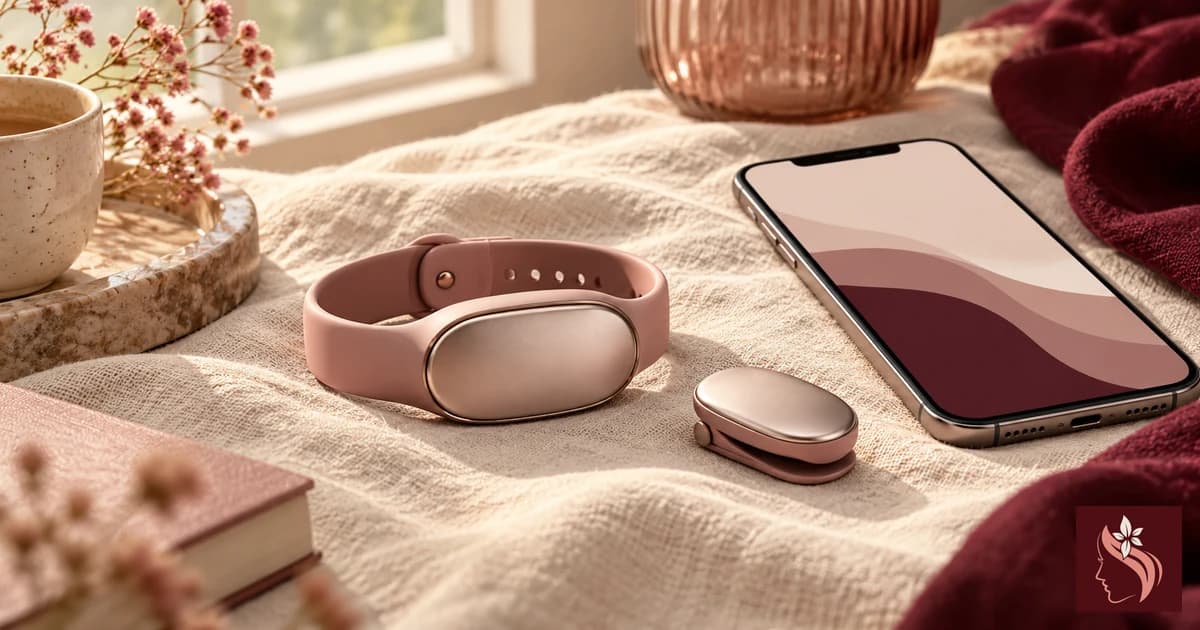
The maker describes an Apollo wearable paired with an app, with selectable vibration programs and options involving intensity, timing, and placement. Its official product page describes wrist or ankle wear and clipping to clothing. Treat these as company-stated features, then confirm the exact package, included accessories, supported phone system, and app requirements on the listing for the model and country you might buy.
A product page may also state usage recommendations, battery duration, price, warranty, or return terms. These details are version- and market-sensitive. Record the date checked and do not carry an older help article into a current listing without confirmation. Illustrative generated visuals in this article are not a photograph of a tested unit. Use official product images when identifying a specific model, and keep the distinction between product photography and editorial illustration clear in captions and alt text.
Sources: apolloneuro.com
The preliminary 2025 student trial
A 2025 preliminary prospective randomized study indexed by PubMed examined Apollo Neuro among medical and pharmacy students. Its abstract describes 66 participants randomized to an active-device group or waitlist control and surveys at baseline, six weeks, and twelve weeks. Outcomes included burnout, well-being, perceived stress, resilience, and alcohol-use measures. At twelve weeks, authors reported improvements in some burnout and well-being scores in the active group relative to controls, while resilience and alcohol-use outcomes did not significantly change.
This result deserves accurate reporting, not a blanket claim of effectiveness. The population was a particular group of health-professional students, the study was preliminary, and outcomes included surveys. Consult the full paper for methods, analysis, funding, conflicts, and limitations instead of relying only on a product summary or abstract. The result does not establish that a consumer device treats anxiety, insomnia, or any other disorder, or that findings transfer to every age, profession, or routine.
Sources: pubmed.ncbi.nlm.nih.gov
A second study adds context
A separate 2025 paper indexed by PubMed evaluated Apollo within a ketamine-assisted-therapy program and compared anxiety-score changes between groups. Its abstract reports a small analyzed sample—16 Apollo participants and 18 controls—and no significant between-group difference in the reported comparisons. Setting, co-intervention, selection, and sample size are central to interpretation. It is not a stand-alone trial of ordinary consumer use and does not establish that a wearable is an anxiety treatment.
Studies can differ because the populations and questions differ. Research in health-professional students and a specialized treatment program cannot be combined into a universal percentage or guaranteed personal outcome. For each paper, inspect randomization, comparator, measure, follow-up, adherence, and author disclosures. Sometimes the accurate conclusion is simply that more independent research is needed. Do not turn an abstract's measured outcome into a different claim such as a treatment effect on sleep unless that exact outcome and context were studied.
Sources: pubmed.ncbi.nlm.nih.gov
Separate research from sales language
Apollo's website makes broader claims about relaxation, sleep, focus, stress, and nervous-system effects. Attribute those statements to Apollo rather than rewriting them as settled clinical facts. Ask whether an independent study tested that exact outcome in a comparable population, with a credible comparison group and a meaningful result. If a paper measured self-reported well-being, do not describe it as a measured physiological change.
Avoid combining different studies, promotional graphics, and testimonials into one impressive-sounding statistic. Marketing pages can update claims or cite work from different populations. Readers should be able to trace a scientific sentence to the exact study supporting it. Where evidence is preliminary, call it preliminary. Where the sources reviewed do not establish a claim, state that clearly. A confident headline cannot replace evidence or remove uncertainty.
Sources: apolloneuro.com; pubmed.ncbi.nlm.nih.gov
Questions to check before purchase
Check the exact model, box contents, band and clip options, phone and operating-system support, account or subscription requirements, charging method, current warranty, return terms, and shipping to your country. These details can differ across editions and regions. If you use an assistive device, have a health condition, or have questions about vibration, sleep, or sensory comfort, ask the manufacturer for instructions and consult a clinician before relying on a general article.
Review data and privacy information too. A connected device may collect account, app, device, or usage data. Read the current privacy notice to understand collection, use, sharing, and account-deletion options. Do not assume app permissions are limited to what a product photo suggests. These are routine consumer questions, separate from whether a study found a particular outcome.
Read device research carefully
Identify the exact technology and version in a study. Evidence on an earlier device, a particular vibration program, or prototype may not validate every current model or app feature. Then assess the design: randomization can reduce some bias, but not every limitation. A waitlist control may differ from a blinded or attention-matched comparison. Sample size, duration, outcome definitions, attrition, adherence, statistical methods, and author relationships all affect what a result can support.
Look for independent replication and transparent funding disclosures. A small pilot can motivate larger research; rarely does it settle a question alone. Systematic reviews are useful only when they include the same technology and relevant population. If outcomes are survey measures, describe them as such. Anyone considering a device for a health concern should discuss options with a clinician, not make treatment decisions from product marketing or an editorial summary.
Price, availability, and affiliate context
Her Glamness does not set Apollo's price, inventory, or shipping terms. The merchant listing should be checked for current U.S. dollars, shipping destination, taxes, return eligibility, warranty, included accessories, and app or subscription conditions. A displayed promotional price can expire. The current-offers page may direct a reader to a partner, but the partner controls checkout and applicable terms.
If an affiliate link or evergreen coupon appears near a product discussion, disclose the relationship clearly and close to the link. A coupon does not establish suitability or strengthen a study. Confirm code terms, market restrictions, exclusions, and destination before presenting it. Editors should periodically verify the route and offer language. Keep specifications separate from commercial details so readers can tell a product feature, a study finding, and a promotion apart.
A practical decision checklist
A practical evidence ledger can keep the article honest: state the feature, identify whether the claim comes from the manufacturer or an independent paper, name the study population and outcome, and then write the boundary of what follows. For example, a survey-based well-being outcome in a student group is not the same thing as a clinical diagnosis, a physiological measurement, or proof of benefit for all consumers. Keep each source attached to the statement it supports instead of placing a large source list at the end and asking readers to infer the connection.
Before publication, editors should reopen the exact wearable page, its support disclosures, and the full papers. Verify product iteration, app features, current phone requirements, study methods, funding, author disclosures, and any changes since the source check date. Do not repeat an old promotional statistic simply because it appears on an official page. If the manufacturer makes a claim and the reviewed peer-reviewed studies do not test that same outcome, say the difference plainly. The merchant controls current price and availability; research controls no sales terms, and a coupon should never be used as evidence.
Conclusion
Apollo Neuro is a consumer wellness wearable described by its maker as an app-connected band and clip that provides patterned vibrations. Published research includes a preliminary randomized study in health-professional students and a separate, small analysis in a specialized treatment context. Those findings concern particular populations and outcomes; they do not establish a universal effect or a medical treatment claim. Keep maker statements and independent findings distinct.
Before purchase, verify model, app compatibility, package contents, privacy information, shipping, returns, and current merchant price. Ask a qualified clinician about personal health questions. This specification-based explainer does not report hands-on testing and does not diagnose, treat, or promise an outcome.


Frequently Asked Questions
Is Apollo Neuro FDA-approved?
Apollo's support page describes it as a consumer wellness device that does not require FDA approval for sale and says it is not intended to treat or cure a medical condition. Recheck the current statement; this is not regulatory advice.
Does research prove Apollo improves sleep for everyone?
No. Published studies examine particular groups and measured outcomes. A preliminary student trial cannot establish universal benefit; study context and limitations matter.
Is Apollo a treatment for anxiety or insomnia?
The maker says the wearable is not intended to treat or cure a medical condition and is not a substitute for professional care. Ask a clinician about symptoms or treatment.
What should I check before buying?
Confirm exact model, accessories, phone compatibility, privacy terms, current price, shipping, returns, warranty, and personal safety questions with the maker or clinician.
Sources
- apolloneuro.com (checked 2026-10-28)
- help.apolloneuro.com (checked 2026-10-28)
- pubmed.ncbi.nlm.nih.gov (checked 2026-10-28)
- pubmed.ncbi.nlm.nih.gov (checked 2026-10-28)