
Compare the written material description, not the shine
Leather and imitation-leather handbags can share colors, textures, silhouettes, and polished product photography. A photo may show a grain pattern or glossy finish, but it cannot establish whether the surface is leather, coated fabric, polyurethane, a composite, or another material. Start with the full materials section and look for the composition of the body, trim, lining, handles, strap, and any visible panel. The Federal Trade Commission’s Guides for Select Leather and Imitation Leather Products cover handbags and address misrepresentation of product composition and other material aspects. This is a U.S. terminology guide, not a laboratory assessment of a particular bag.
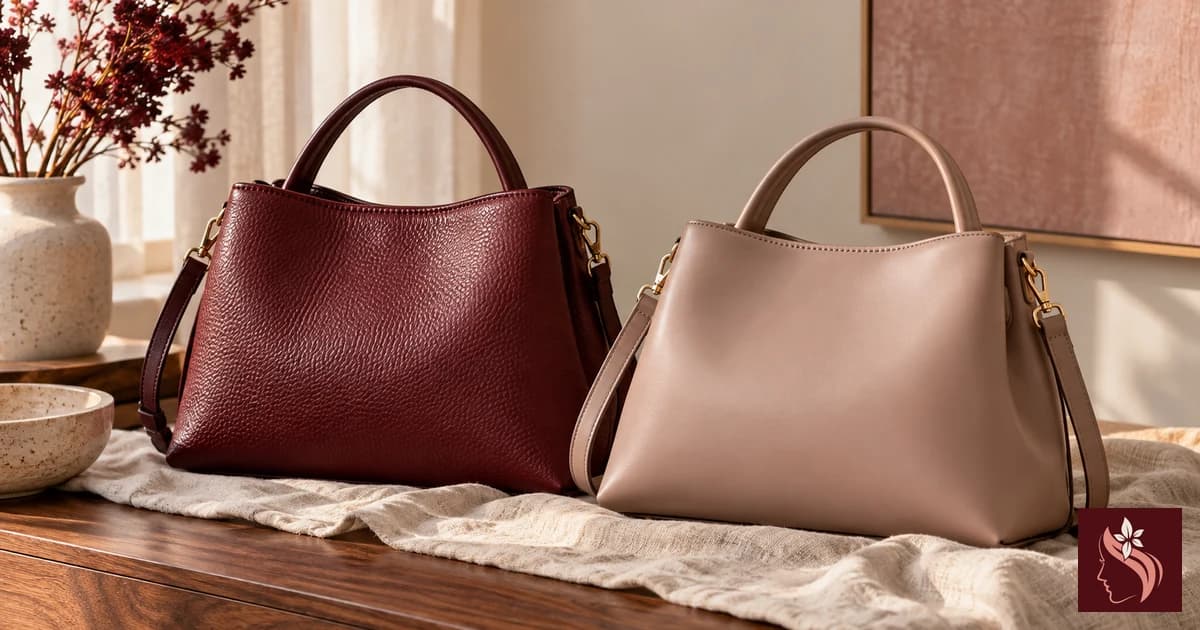
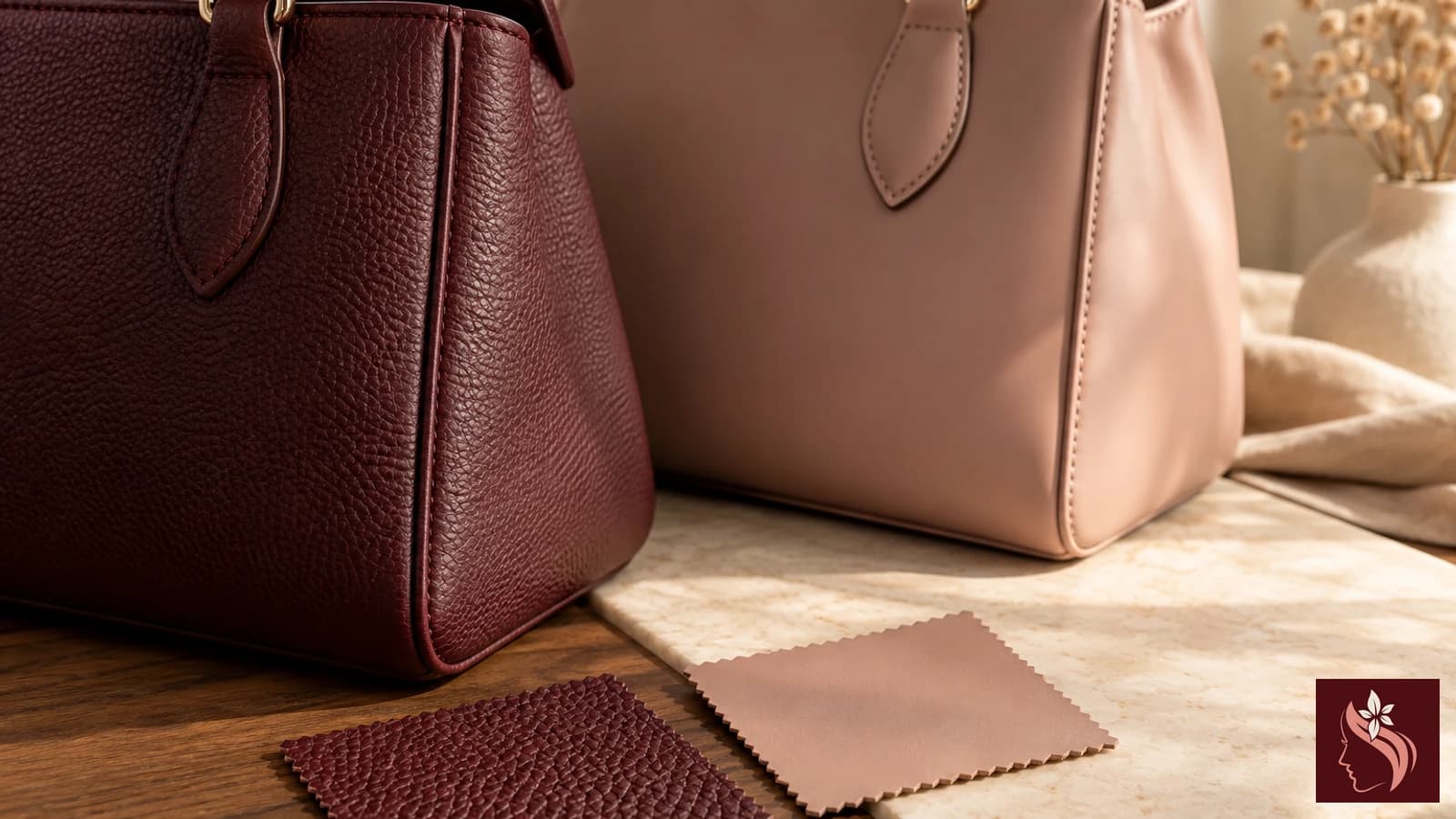
The word “faux” is a broad consumer-facing descriptor and may not identify the specific material used in a bag. “Vegan leather” also does not, by itself, name the polymer, textile backing, coating, or construction. Ask the seller what material the product contains and which parts are made from it. The images in this article are generated editorial illustrations, not exact products and not evidence of a material test. The product-testing box expresses the publisher’s overall method; we are not claiming to have handled or tested either bag pictured.
What U.S. leather guidance tells shoppers
The FTC leather guides say it can be deceptive to misrepresent the composition of leather and imitation-leather products. They address use of the unqualified term “leather” and describe disclosure when a product or part is made from a non-leather material that appears to be leather. The guidance also covers handbags and related products. For a shopper, this makes the exact description important: read whether it identifies leather type or a material such as coated fabric, synthetic material, or another specified composition. When the page says only “leather look,” ask what the product is actually made from.
A handbag may combine materials: a leather body with synthetic lining, imitation-leather trim with textile panels, or a mixed construction across the front, sides, and base. The listing should not leave you to guess which material applies to which section. Look for a material breakdown by component and compare it with the product’s label or manufacturer page. The U.S. guides are about truthful representation, not a ranking of sustainability, quality, softness, or lifespan. Those claims need separate evidence. If the seller gives a general statement that conflicts with the item-level specification, ask which one describes the selected product.
Sources: ftc.gov
Separate leather, imitation leather, and mixed construction
Leather comes from animal hide or skin; imitation materials are made to resemble leather. The product record should tell you which type is used and whether the bag includes split leather, bonded or reconstituted material, coated surfaces, or synthetic components where relevant. Do not rely on broad labels such as “genuine,” “vegan,” or “premium” to answer every construction question. If a seller uses a technical term, ask it to explain the term and identify the part of the bag it describes. FTC guidance is useful for checking that a material claim is not misleading, but the product listing must still provide the actual item details.
For mixed construction, ask about each area that affects your use: outer body, base, handles, strap, corners, seams, trim, lining, and pocket. A bag’s visible face may differ from the underside or interior. If the strap is removable, determine whether it uses the same material as the bag body. If a product has a coating, ask what care is recommended and whether the surface can be repaired. Written answers help you compare products across merchants; they are more reliable than matching a texture to a mental image of leather.
Sources: ftc.gov
Inspect construction fields beyond the material name
A material label is only one part of a useful handbag comparison. Check the bag’s measurements, weight if supplied, closure type, handle drop, strap length and adjustment range, interior pockets, base structure, hardware, seam details, and return policy. These features help you decide whether the bag fits your routine without claiming it will carry a certain load or last a fixed number of years. If the merchant gives a capacity or weight limit, record the exact wording and use conditions. Do not infer load performance from a photo of the bag standing upright on a studio table.
Look at stitching and edge finishing in product images, but treat those as visual cues rather than proof of construction quality. A close-up may help you ask whether a seam is reinforced or whether the strap attaches to a separate tab; it cannot show the strength of the thread or hardware under use. For a bag you plan to carry daily, check whether the strap length works over the clothing you wear and whether the closure is easy to operate. If the product page omits a dimension that matters, contact the seller before ordering rather than estimating from a model image.

Care depends on the exact material and finish
Follow the maker’s care instructions for the exact handbag. Leather types, coatings, dyes, adhesives, synthetic surfaces, and linings can respond differently to moisture, heat, cleaners, oils, and friction. A treatment intended for one leather finish may discolor another material or damage imitation leather. Do not apply conditioner, waterproofing spray, or household cleaner just because it is popular for bags. First check whether the manufacturer permits it and whether the product is appropriate for all components. If instructions are missing, ask the maker or seller before spot-cleaning a visible area.
For everyday storage, keep the bag in a clean, dry place away from direct sunlight and excessive heat when the maker recommends that approach. Support its shape without overfilling it, store detachable straps so they do not press marks into the body, and avoid placing a damp or dirty item directly against other materials. These general organization habits do not replace the maker’s directions and cannot prevent every change from use. If a spill or stain occurs, consult the product’s care page promptly; an improvised solvent may spread or set the mark. For a valuable bag, a professional cleaner who handles that material may be appropriate.
Interpret ‘vegan’ and environmental claims carefully
A vegan label usually communicates that a product is not made with animal-derived material under the seller’s definition, but it does not specify the material or prove an environmental benefit. An imitation-leather bag might use polyurethane, PVC, a coated textile, or another construction; the seller should identify the material. Do not assume that an item is biodegradable, recyclable, lower-impact, or more durable just because it is described as vegan. Those are separate claims and should be supported by product-specific evidence about the material, manufacturing, use, and end-of-life route.
If animal-derived materials are a deciding factor, review the seller’s full materials statement and ask whether trims, adhesives, or lining contain other components that matter to you. If environmental impact is your concern, look for a clear, bounded claim and a source that explains the scope, not a leaf symbol or general brand promise. Her Glamness does not make unsupported sustainability comparisons from material names alone. A well-described product may still be the right personal choice for style, price, or care preference, but the reader should be able to tell what the claim does and does not establish.
Sources: ftc.gov
A handbag listing checklist
Before comparing two bags, capture the exact model and variant, the material for each major component, the dimensions, strap drop and adjustment range, lining, closure, care directions, repair or warranty policy, and return terms. Ask whether the product images show the exact variant and whether the material statement applies to the entire bag or only the outer body. Check that the selected color does not use a different finish or construction. Record the date you reviewed the product page because product details and availability can change.
If the answer to a material question is “not stated,” mark it that way. Do not infer composition from smell, feel, texture, price, or the appearance of stitching in a listing photo. A consumer cannot reliably establish a product’s construction by zooming in on a web image. Ask the merchant for the full description, choose a clearer listing, or decide whether the unanswered question matters to your purchase. Current pricing and stock belong to the merchant. Affiliate links, when used, should not replace transparent product data or an honest account of what Her Glamness could verify.
Sources: ftc.gov

Conclusion
To compare leather and faux-leather handbags, verify the exact material for the body and its other components, then review dimensions, construction details, care instructions, and return terms. The FTC’s U.S. guidance addresses truthful leather and imitation-leather descriptions, while a product-specific manufacturer record tells you what the particular bag is made from. Appearance cannot establish composition, and terms such as vegan or premium do not prove durability or environmental benefit. When a listing leaves a material unanswered, ask the seller or choose a better-documented product rather than guessing from the photograph.
Frequently Asked Questions
Is faux leather the same material as vegan leather?
Not necessarily. Both terms can cover different constructions, and neither name alone identifies the exact material. Check the seller’s component-level description.
Can I tell whether a handbag is leather from a product photo?
No. A photo may show texture and construction details but cannot verify composition. Use the manufacturer’s materials disclosure and ask the seller when a component is unclear.
Does vegan leather mean a bag is sustainable?
No. Vegan describes an animal-material claim under the seller’s definition; it does not establish environmental impact, durability, recyclability, or biodegradability.
How should I clean a faux-leather handbag?
Follow the maker’s instructions for the exact material and finish. Do not assume a leather conditioner or household cleaner is suitable for imitation materials.